Paper Wasps
Paper wasps commonly build open, umbrella-shaped nests beneath eaves, porch ceilings, decks, railings, shutters and overhangs.
Stinging insects can build nests around rooflines, decks, sheds, wall voids, trees and underground areas. Howey Pest Solutions provides professional treatment for wasps, yellow jackets, bald-faced hornets and other stinging insects throughout Northern New Jersey.
Wasps, hornets and yellow jackets can become defensive when their nest is disturbed. Activity often increases during late summer and early fall as colonies grow larger and food becomes harder to find.
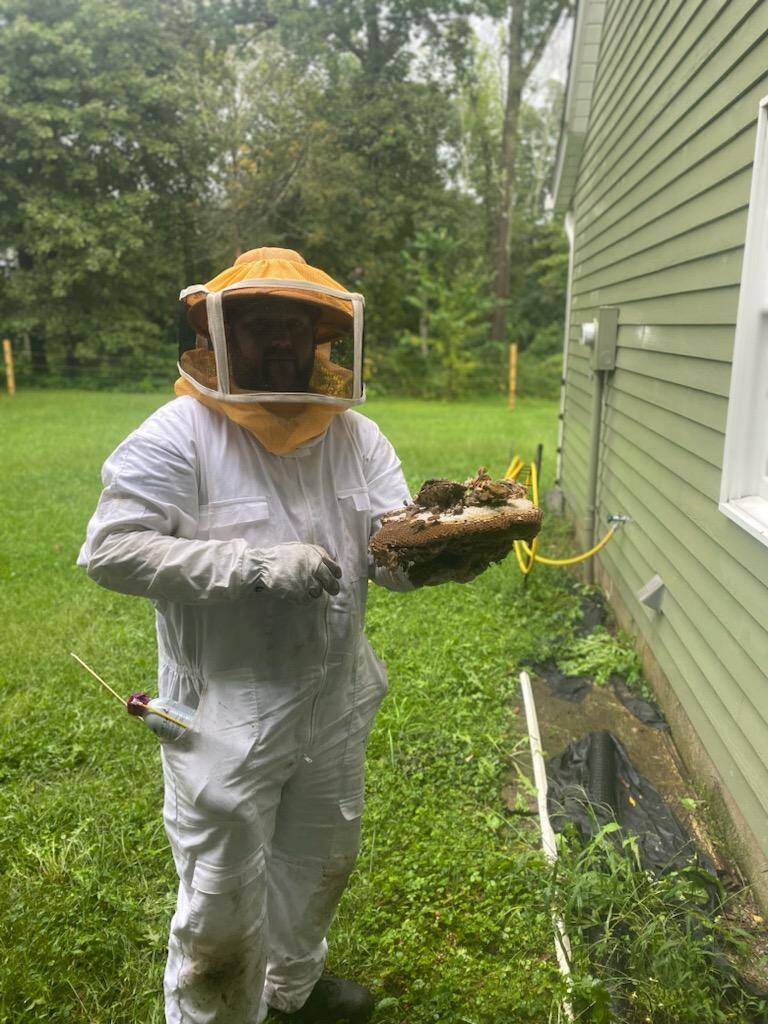
Our technicians inspect the area, identify the insect whenever possible and apply treatment based on the nest location. When a nest is safely accessible, removal may also be completed as part of the service.
Repeated insect traffic into a hole, wall opening, roofline, foundation gap or underground entrance usually indicates an active nest nearby. Avoid sealing the opening before treatment, especially when the nest may be inside the structure.
Different species build nests in different locations and may require different treatment methods.
Paper wasps commonly build open, umbrella-shaped nests beneath eaves, porch ceilings, decks, railings, shutters and overhangs.
Yellow jackets frequently nest underground, inside wall voids, under siding, near foundations and in abandoned rodent burrows.
Bald-faced hornets build large gray paper nests in trees, shrubs, rooflines, utility structures and other elevated locations.
Wasps and yellow jackets may enter through small openings and establish nests inside walls, soffits, attics or ceiling voids.
Yellow jackets often use holes in lawns, landscaping, stone walls and wooded areas as nesting locations.
Hornet nests may be hidden by leaves and become easier to notice as the colony grows or foliage begins to thin.
The proper treatment depends on whether the nest is exposed, underground or hidden inside a structure. We inspect the activity before applying the appropriate professional treatment.
We identify where insects are entering, traveling and nesting while evaluating any safety concerns around the area.
We determine whether the nest is exposed, underground, inside a wall void or located in another concealed area.
Treatment is applied directly to the nest, entrance or active travel area using the proper method for the situation.
Accessible exposed nests may be removed after treatment when it is safe and practical to do so.
If covered activity continues from the treated nest or entry point during the guarantee period, contact our office to schedule a follow-up inspection and treatment. New nests or activity in a separate location are considered a new pest issue.
Avoid disturbing the nest and keep family members, pets and visitors away from the area until it can be professionally treated.
Qualifying Home Defense Plans include treatment for paper wasps, yellow jackets and bald-faced hornets located on or around the covered home. Service calls are available between scheduled visits for covered pest activity.
Compare Home Defense PlansHowey Pest Solutions provides treatment for wasps, hornets and yellow jackets throughout Sussex County, Morris County, Warren County and parts of Passaic County.
Paper wasps usually build open comb nests beneath protected surfaces. Yellow jackets often nest underground or inside structural voids. Bald-faced hornets build large enclosed paper nests in trees, shrubs and elevated areas.
No. Sealing an active entrance before the nest has been treated may force the insects to search for another exit, including through walls or ceilings into the home.
Accessible exposed nests may be removed after treatment when it is safe and practical. Hidden wall-void or underground nests may not be physically removable.
Activity commonly decreases after treatment, but insects may remain visible temporarily as workers return to the treated nest or contact the treatment.
Bald-faced hornet colonies generally do not reuse the same nest the following year. New queens establish new nests each season, although a favorable property may experience new activity.
Qualifying treatments include a 30-day guarantee for activity associated with the treated nest or entry point. New nests in separate locations are not covered under the original service.
Yes. Qualifying Home Defense Plans include treatment for paper wasps, yellow jackets and bald-faced hornets located on or around the covered home.
Yellow jacket colonies become larger throughout the summer and are often most noticeable and defensive during late summer and early fall.
Keep a safe distance and contact Howey Pest Solutions. We will inspect the activity, identify the nesting area and provide the appropriate professional treatment.